The job market is changing faster than ever. Artificial Intelligence, automation, and digital transformation are reshaping industries at an unprecedented pace. By 2030, the World Economic Forum predicts that 85 million jobs may be displaced, while 97 million new jobs will emerge — many of which don’t even exist today.
In this rapidly evolving landscape, technical skills alone are no longer enough. The most successful professionals will be those who combine human skills with emerging technologies.
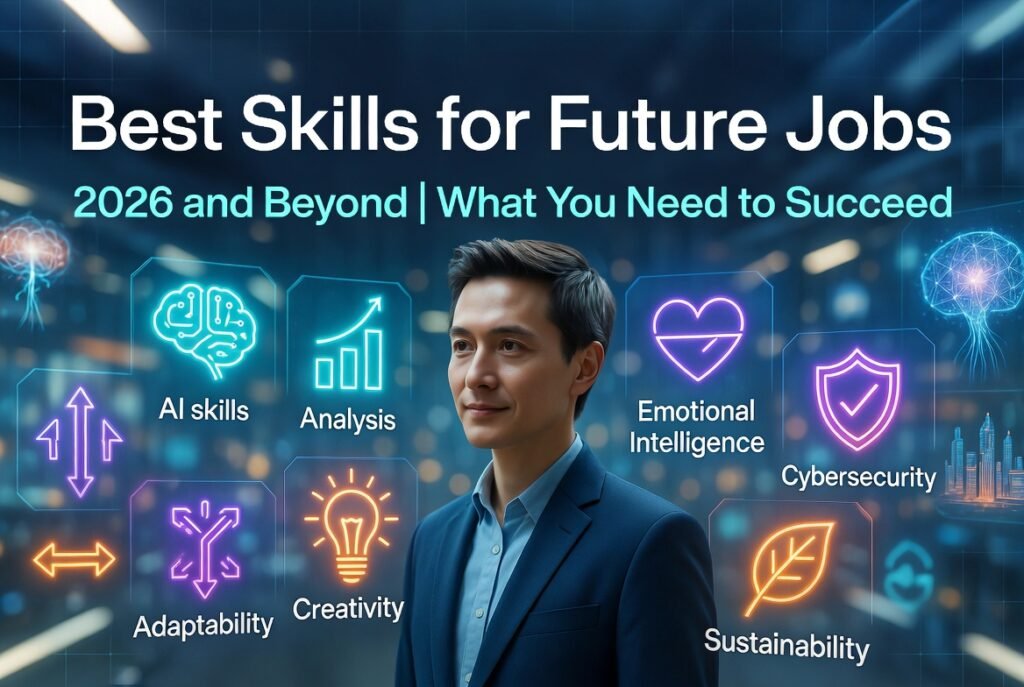
Here are the Best Skills for Future Jobs that will give you a massive competitive advantage in 2026 and the coming decade.
1. AI Literacy & Prompt Engineering (The #1 Skill)
Understanding how to work with AI is no longer optional — it’s essential. Future jobs will demand professionals who can effectively collaborate with AI tools rather than compete against them.
Key abilities include:
- Writing effective prompts for tools like ChatGPT, Claude, and Grok
- Using AI for data analysis, content creation, and decision making
- Understanding AI limitations and ethics
Why it matters: Companies are actively looking for “AI-fluent” employees who can boost productivity by 40% or more.
2. Data Analysis & Interpretation
Data is the new oil. Every industry — from healthcare to marketing to finance — is drowning in data.
Future-ready professionals must know how to:
- Collect, clean, and analyze data
- Use tools like Google Analytics 4, Tableau, Power BI, and Python
- Turn raw data into actionable business insights
Even non-technical roles will require basic data literacy.
3. Critical Thinking & Complex Problem-Solving
While AI can handle routine tasks, humans will still be needed for complex, ambiguous problems.
This skill involves:
- Analyzing situations from multiple angles
- Making decisions with incomplete information
- Identifying root causes instead of treating symptoms
Employers consistently rank critical thinking as one of the top 3 most important skills for the future.
4. Emotional Intelligence (EQ) & Empathy
As automation takes over technical tasks, human skills become more valuable.
High EQ includes:
- Self-awareness and self-regulation
- Empathy and active listening
- Building strong relationships and team collaboration
Leaders with high emotional intelligence will be in high demand, especially in hybrid and remote work environments.
5. Adaptability & Lifelong Learning
The average person will change careers 5–7 times in their lifetime.
Future-proof professionals must:
- Learn new skills quickly
- Stay curious and open to change
- Embrace continuous learning platforms (Coursera, LinkedIn Learning, etc.)
6. Digital Collaboration & Remote Work Skills
Remote and hybrid work is here to stay. Future jobs will require:
- Proficiency in tools like Slack, Microsoft Teams, Notion, and Zoom
- Excellent written communication
- Ability to build trust and culture in virtual teams
7. Creative Thinking & Innovation
AI is excellent at optimization, but creativity remains uniquely human.
Companies will pay premium for people who can:
- Think outside the box
- Generate original ideas
- Combine concepts from different fields (interdisciplinary thinking)
8. Cybersecurity Awareness & Digital Ethics
With increasing digital dependence comes greater risk.
Basic knowledge of:
- Data privacy and protection
- Ethical use of AI and technology
- Spotting cyber threats
will become important even for non-technical roles.
9. Sustainability & Green Skills
Climate change and ESG (Environmental, Social, Governance) factors are becoming central to business strategy.
Skills in sustainable practices, circular economy, and green technology will be highly valued across industries.
10. Communication & Storytelling
The ability to explain complex ideas simply is incredibly powerful.
Future leaders must master:
- Persuasive writing and speaking
- Data storytelling (turning numbers into compelling narratives)
- Personal branding on platforms like LinkedIn
How to Start Building These Skills Today
- Daily AI Practice – Use ChatGPT or Grok for at least 30 minutes every day
- Take online courses – Google Career Certificates, IBM Data Science, etc.
- Build real projects – Create a portfolio showcasing your skills
- Network actively – Join relevant LinkedIn groups and communities
- Read regularly – Stay updated with trends in technology and business
Final Thought
The future doesn’t belong to those with the highest IQ or the most degrees. It belongs to those who can learn fast, adapt quickly, and combine human skills with technology.
Start developing these Best Skills for Future Jobs today, and you won’t just survive the future — you’ll thrive in it.
The question is not whether these changes will happen. The question is: Will you be ready?