
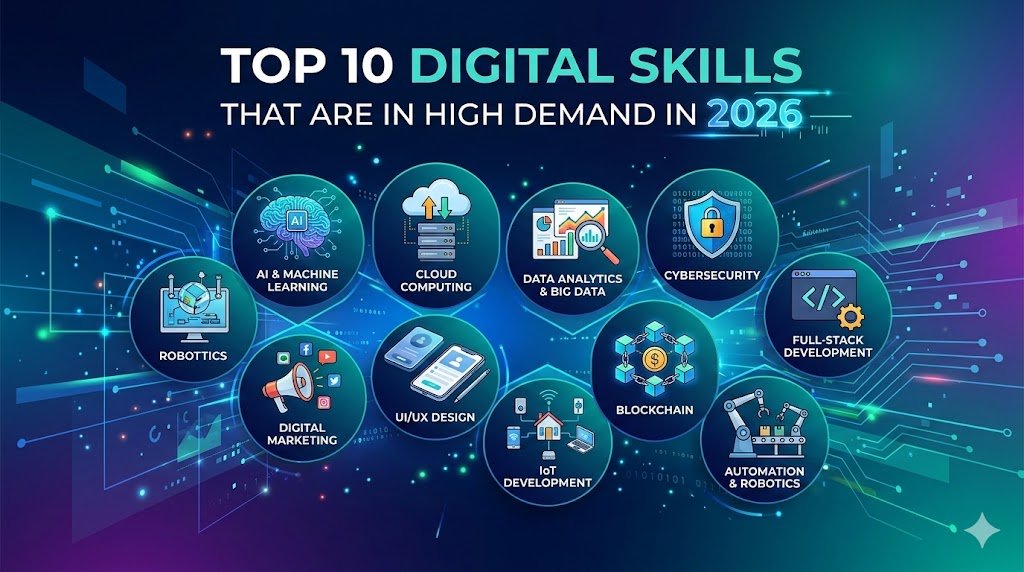
The job market in 2026 is evolving faster than ever, driven by AI adoption, digital transformation, and the need for human-centric abilities in an automated world. According to reports from LinkedIn, Coursera, World Economic Forum, Cornerstone, and Upwork (as of early 2026), technical skills like AI and data are exploding, but soft skills—leadership, adaptability, and critical thinking—are rising even faster to complement them. Employers want people who can use AI tools effectively while solving complex problems and collaborating in hybrid teams.
Whether you’re in Pakistan, India, or globally, mastering these skills can boost your employability, salary potential, and career resilience. Here’s the top 10 in-demand skills for 2026, with why they matter and how to build them.
1. Generative AI & Prompt Engineering
AI isn’t just a buzzword—it’s core to workflows. Generative AI (GenAI), prompt engineering, and tools like ChatGPT, Gemini, or LLMs top lists from Coursera and LinkedIn. Demand surged +245% in some reports.
Why it matters: Businesses use AI for content, code, automation, and insights. Prompt engineering turns vague ideas into precise outputs.
How to build it: Take free Coursera/Google courses on Generative AI, practice daily with tools, build projects (e.g., AI chatbots).
2. Data Analysis & Analytics
Data drives decisions everywhere. Skills in collecting, interpreting, and visualizing data (using Python, SQL, Excel, Tableau) remain essential.
Why it matters: Companies need insights from massive datasets. Coursera ranks it high for high-income roles.
How to build it: Learn via Coursera’s Google Data Analytics Certificate or free Kaggle courses. Focus on real datasets.
3. Cybersecurity
With rising cyber threats, protecting data and systems is critical. Skills in threat detection, compliance, and AI-enhanced security are booming.
Why it matters: Breaches cost millions; every industry needs experts.
How to build it: Start with CompTIA Security+ or Coursera’s IBM Cybersecurity Professional Certificate.
4. Analytical & Critical Thinking
World Economic Forum and multiple sources rank this #1 core skill. It’s about breaking down problems, evaluating evidence, and making reasoned decisions.
Why it matters: AI handles routine tasks; humans tackle complex, ambiguous issues.
How to build it: Practice case studies, puzzles, or courses on logical reasoning.
5. Adaptability & Continuous Learning
The ability to learn quickly and pivot is key in a fast-changing world.
Why it matters: Jobs shift rapidly; lifelong learners thrive.
How to build it: Set learning goals, use platforms like LinkedIn Learning or Coursera, track progress.
6. Leadership & People Management
Skills like mentorship, team management, cross-functional collaboration, and emotional intelligence are surging (LinkedIn notes doubling in some areas).
Why it matters: Hybrid/remote work needs strong human leaders.
How to build it: Volunteer for team roles, take leadership courses, practice empathy.
7. Cloud Computing
AWS, Azure, Google Cloud skills enable scalable, secure infrastructure.
Why it matters: Most businesses are cloud-first.
How to build it: Earn AWS Certified Cloud Practitioner or Azure Fundamentals certification.
8. Communication & Storytelling
Clear writing, presenting, stakeholder communication—even storytelling with data—are rising.
Why it matters: AI outputs need human explanation; remote teams rely on strong comms.
How to build it: Practice public speaking (Toastmasters), write blogs, or take courses.
9. Machine Learning & AI Implementation
Beyond basics, deploying ML models, AutoML, and integration skills are hot.
Why it matters: Companies move from experimentation to production AI.
How to build it: Andrew Ng’s Coursera ML course, then build projects.
10. Project Management
Coordinating AI projects, teams, and timelines—with tools like Agile/Scrum.
Why it matters: Turns ideas into results amid uncertainty.
How to build it: Get PMP or Google Project Management Certificate.
Bonus Tips for 2026 Success
- Balance tech + human skills: AI literacy + emotional intelligence wins.
- Tailor to your field: In Pakistan/India, focus on AI, digital marketing, freelancing (Upwork trends).
- Build proof: Create portfolios, GitHub repos, certifications.
- Stay updated: Follow LinkedIn reports, Coursera trends.
Mastering these skills positions you for high-demand, high-paying roles in an AI-driven economy. Start small—pick one or two, dedicate time weekly. Your future career depends on what you learn today.
The world of work rewards those who adapt and add value. Which skill will you tackle first? Share in the comments!